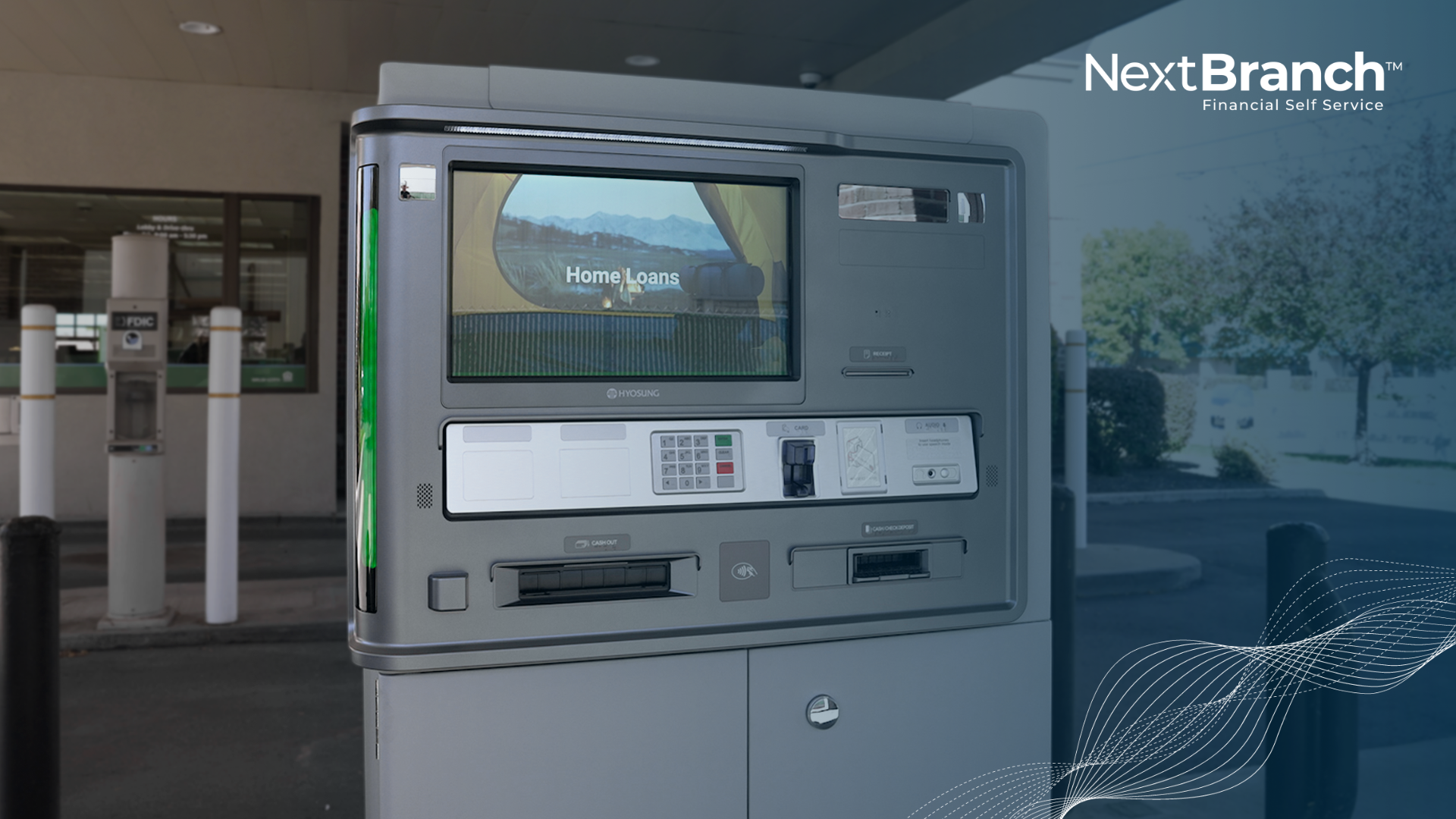
Key Takeaways
- An ATM handles cash withdrawals, deposits, balances, and transfers. An ITM handles those plus loan payments, check cashing, access to every account, and a live teller on video.
- An ITM costs about $20,000 to $30,000 more per machine. Core integration, which most ITM transactions depend on, is a separate one-time project quoted for the whole fleet.
- Most institutions need both machines. Choose for each location based on the transactions it handles.
- Up to 90 percent of teller transactions can move to a core-integrated ITM. An ATM moves only cash withdrawals and deposits.
In the ITM vs ATM decision, start with the transactions you want to move off the teller line. If that list is cash withdrawals and deposits, an ATM handles it for roughly $40,000 to $50,000 installed. If it includes loan payments, check cashing, and access to every account a customer or member holds, you need an interactive teller machine connected to your core.
Most banks and credit unions end up running both. The lobby that is losing a teller window gets an ITM, and the off-site drive-up that only dispenses cash keeps an ATM.
What each machine can do
An ATM can complete only the transactions the card network supports. An ITM connected to the core can complete most routine teller transactions. Account opening, cashier's checks, and new loans still go to staff.
| Capability | ATM | ITM |
| Cash withdrawal and deposit | Yes | Yes |
| Balance inquiry, transfer between checking and savings | Yes | Yes |
| Access to every account, including loans and credit cards | No | Yes, with core integration |
| Loan payment by cash, check, or transfer | No | Yes, with core integration |
| Check cashing | No | Yes, with teller approval on video |
| Withdrawal limit | Network limit | Set by the institution |
| Cardless access (account number, phone, username) | No | Yes, with core integration |
| Live teller on video | No | Yes, during video hours |
| Self-service hours | 24/7 | 24/7 for self-service; video hours set by the institution |
Core integration is behind most of the ITM column. Without it, an ITM can still open a video session, but the teller has to complete a loan payment or cash a check by hand and then key it into the core a second time. With it, the machine posts the transaction once and the teller only approves it. That one difference sets how many tellers an ITM program needs.
What each one costs
An ITM costs about $20,000 to $30,000 more than a comparable ATM. Core integration is a separate one-time project, and its cost stays about the same whether it connects four machines or forty.
| Cost line | ATM | ITM |
| Machine, installed | Roughly $40,000 to $50,000 | Roughly $60,000 to $80,000 |
| Core integration | Not needed | One-time project, quoted for the whole fleet |
| Video teller software | None | A few thousand dollars per machine per year |
| Service and compliance | Under $10,000 a year, plus under $10,000 per compliance cycle | Similar per machine |
| Teller staffing | None | One teller per 2 to 4 machines (video-teller-driven) or per 15 to 20 (assisted self-service) |
Two lines in that table move the budget more than the machine price. Integration is the first: a four-machine pilot carries the whole project, while a twelve-machine program spreads it out. Staffing is the second. Ten ITMs run on the video-teller-driven model need three to five tellers on the video desk during video hours. The same ten machines on the assisted self-service model need one.
What the ITM takes off the teller line
A core-integrated ITM can take up to 90 percent of the transactions that now go to the teller line, including withdrawals, deposits, loan payments, check cashing, and transfers between accounts. The work that stays with staff is the work a machine cannot do: opening accounts, issuing cashier's checks, and starting a loan. In a typical ITM branch, that work goes to one traditional teller station with a cash recycler, and a universal banker greets people and approves ITM transactions from a tablet.
An ATM moves cash withdrawals and deposits off the line. If most of a branch's teller volume is loan payments and check cashing, an ATM in place of the teller window changes very little.
Where an ATM is the better choice
An ATM fits a location that only needs cash, has no staff nearby, or sits in a fleet with no plan to integrate with the core. An off-site drive-up, a cash-only machine in a hospital lobby, and a second lane at a busy branch drive-up are typical ATM locations. An ITM at any of them adds $20,000 to $30,000 for a screen and camera that few transactions will use.
Timing can also decide it. An institution that must replace an end-of-life fleet this year and convert its core next year can buy ATMs now, or buy ITMs, turn on video teller first, and connect them to the core after the conversion. Until the integration is live, remote tellers complete those transactions by hand.
Where an ITM is the better choice
An ITM fits where it replaces teller work, where the branch has to run with fewer people or in less space, or where customers and members need transactions the card network cannot complete. In a lobby, ITMs let a branch open with a universal banker and a tablet in place of a teller line. At the drive-up, they let a branch run without tellers on site, with a remote teller available on video.
Space is the other reason. Because a core-integrated ITM can take loan payments and cash checks, a small-format branch can run without a full teller line. An ATM cannot support that kind of branch, because it cannot complete those transactions.
Choosing a machine for each location
Decide one location at a time, from the transactions that location handles.
| The location | The machine |
| Cash and deposits only, no staff nearby | ATM |
| Replacing a teller window in a lobby | ITM, core integrated |
| Drive-up lane at a branch with a teller line inside | ATM, or ITM if the lane carries loan payments |
| Drive-up at a branch with no tellers on site | ITM with video teller |
| Small-format or extended-hours branch | ITM, core integrated |
| Fleet refresh with a core conversion in the next 18 months | ATM now, or ITM with integration after the conversion |
Count the ITMs before you price core integration. The project costs about the same for four machines as for fourteen, so a pilot usually looks weaker on paper than the full program.
NextBranch provides fully outsourced ATM, ITM, and teller cash recycler services to banks and credit unions, with more than 7,000 machines under management and 99 percent fleet uptime in 2025. Ask for a machine-by-machine fleet assessment.
Frequently Asked Questions
What is the difference between an ITM and an ATM?
An ATM completes the transactions a card network supports: withdrawals, deposits, balances, and transfers. An ITM adds a live teller on video and, with core integration, access to every account, loan payments, check cashing, and withdrawal limits the institution sets.
Can an ITM replace a teller?
An ITM takes over routine transaction work, but it does not replace the people. The remote tellers who answer video sessions are your own employees, and account opening, cashier's checks, and new loans stay with branch staff.
Does an ITM work without core integration?
Yes, as a video teller machine. The remote teller completes transactions the ATM network cannot handle and records them in the core by hand. Core integration removes that second step and lets most transactions finish without a teller, which moves the staffing ratio from one teller per two to four machines to one per 15 or more.