Key Takeaways
- A teller cash recycler (TCR) takes the place of the teller's cash drawer. It counts, authenticates, stores, and pays out notes, and it reuses deposited cash for the next withdrawal.
- Reusing deposits is what cuts hand counts, drawer balancing, vault trips, and the size of armored courier orders.
- A typical TCR weighs about 2,000 pounds and holds the branch's working cash, so many branches use it in place of a vault room.
- Teller platform integration decides most of the return, because it lets tellers enter each transaction once.
- A new TCR costs around $30,000, before deployment, service, compliance upgrades, and integration.
A teller cash recycler, or TCR, is a secured machine at the teller station that takes the place of the cash drawer. It counts, authenticates, stores, and pays out cash, and it puts the notes that customers and members deposit back into inventory for the next withdrawal.
That reuse of deposits is where the savings come from: fewer hand counts, no drawer to balance at close, fewer vault trips, and smaller courier orders. To get those savings, the TCR has to replace the drawer completely. That depends on two things more than the choice of model: integration with the teller platform and a firm date when the drawers close.
How Cash Moves at a Teller Line Without a TCR
In most branches, each teller counts a drawer out of the vault in the morning, takes in and pays out cash by hand all day, and counts the drawer again at close. A variance at close means a recount by two people under dual control. Cash orders go to the armored courier on a fixed schedule, and the branch manager has to guess the right amount. Order too much and cash sits idle in the vault. Order too little and the branch runs short of twenties on a Friday.
The cost of this routine is mostly staff time, and it grows with every teller station. Each person at the counter needs a drawer, a vault trip, and a balancing routine before they can serve anyone, which is one reason branches find it hard to run with fewer people.
What Is a Teller Cash Recycler?
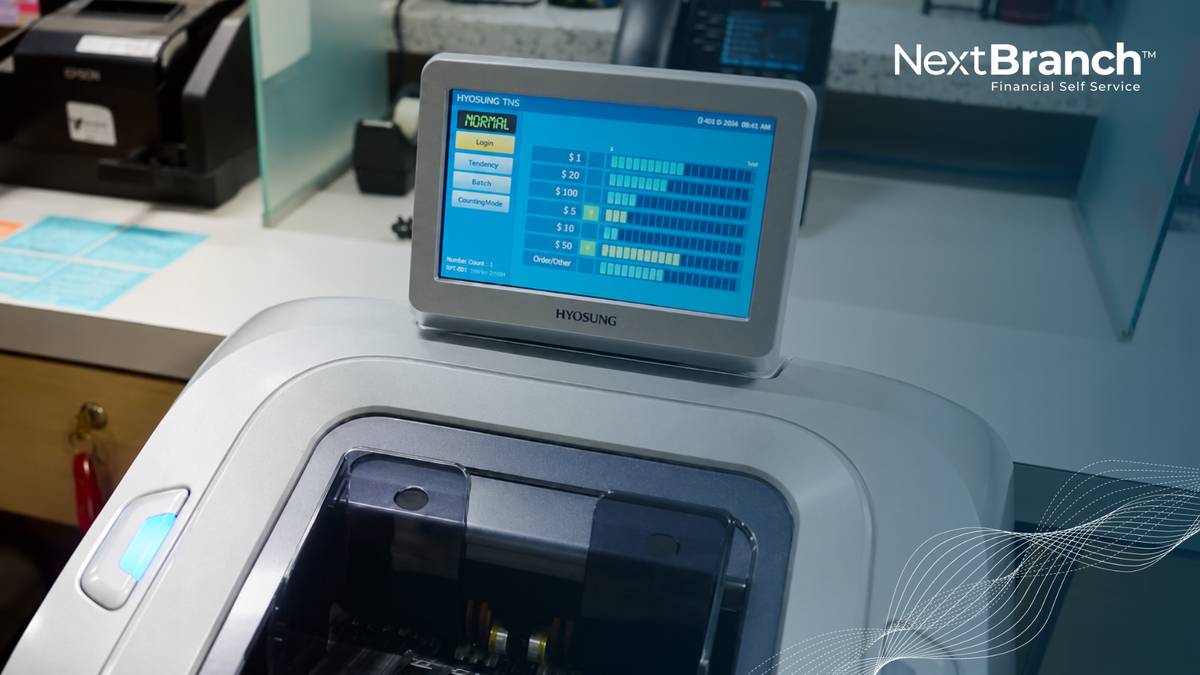
A teller cash recycler is a cash automation machine built for the teller line. The teller enters the transaction in the teller application. The TCR takes in the deposited notes, checks each one for authenticity, sorts it by denomination, and stores it in locked cassettes. For a withdrawal, it counts out the exact notes and presents them to the teller. Many models accept an optional coin dispenser, so tellers can stop counting coin as well.
A typical TCR weighs about 2,000 pounds, and its safe is built to hold the branch's working cash. For that reason, many branches use the TCR as their vault and do not build a separate vault room. Bankers and vendors also call it a TCR machine or a cash recycler machine.
How a Cash Recycler Works
A cash recycler joins two cash flows that a drawer keeps apart. In a drawer-based branch, deposits go to the vault and then out with the courier, and withdrawals come from cash the branch ordered. In a TCR, a $20 note that one member deposits at 10:00 can go out in another member's withdrawal at 10:05. The machine tracks its own balance by denomination, so nobody balances a drawer at close, and it authenticates every note, so tellers stop checking for counterfeits by hand.
The reuse of cash also changes the courier schedule. A branch with recyclers needs less cash on hand to meet the same demand, so it can order less often or in smaller amounts. How much less depends on the branch. A branch where deposits and withdrawals are close to equal reuses most of its cash. A branch where withdrawals are much larger than deposits still needs regular orders.
The one cash movement that still involves people is the transfer between machines or between a machine and the vault. Hyosung, the manufacturer NextBranch has partnered with for more than 20 years, uses transit cassettes for this. A sealed cassette goes into a docking station outside the TCR vault. The teller processes the cash sell on one machine, and the same cassette goes to the next TCR to process the cash buy. The cash is never exposed during the transfer, so much of the dual-control work for a traditional cash buy and sell goes away.
TCR vs. Teller Cash Dispenser, Cash Recycling ATM, and ITM
The difference between these machines is who uses them and whether they reuse deposited cash.
| Machine | Who uses it | Where it sits | Reuses deposited cash |
| Teller cash recycler (TCR) | Teller or universal banker | At the teller station or banker pod | Yes |
| Teller cash dispenser (TCD) | Teller | At the teller station | No. It pays out only, and deposits still go in a drawer |
| Cash recycling ATM | Customer or member | Lobby, drive-up, or through the wall | Yes |
| Interactive teller machine (ITM) | Customer or member, with a remote video teller when needed | Lobby or drive-up | Depends on the model |
A teller cash dispenser automates only the payout, so tellers still count every deposit by hand. A cash recycling ATM gives self-service customers and members the same reuse of cash. An interactive teller machine adds a remote video teller, check cashing, denomination selection, and core integration that gives consumers access to all their accounts self-service.
In a redesigned branch, these machines work together. ITMs handle the routine deposits and withdrawals, and a TCR at one or two stations handles the cash for work that still needs a person, such as opening an account or issuing a cashier's check. Retail cash recyclers are a separate product. They serve cashiers at a point of sale and are not built for teller workflows or for integration with a bank or credit union's systems.
What Changes in the Branch
The largest change is the layout. When the TCR holds the working cash, the branch may not need a vault room. When ITMs take the routine transactions, one or two teller stations with a TCR can cover the rest. That is how branch transformation projects get to a smaller footprint, and it is why the TCR is usually part of the plan from the first drawing.
The staff change follows from the layout. Tellers stop counting, balancing, and recounting, and transactions at the counter go faster. In a branch with fewer stations, the people who once managed cash can spend that time on lending, advice, and growing relationships with customers and members.
Accuracy improves too. The machine authenticates and records every note, so most of the end-of-day variances that start a dual-control recount do not happen.
The branches that get the most from a TCR plan the change. They train tellers before go-live, set a date when the drawers close, and connect the TCR to the teller platform before that date.
What a TCR Costs
A new teller cash recycler costs around $30,000 for the machine. After that, the annual cost comes from deployment, service, compliance upgrades, and integration with the teller platform. Integration varies the most from one institution to the next, because platforms price it in different ways.
The full breakdown of teller cash recycler cost lists each item, compares the integration pricing models, and gives the annual total over a seven-year and a ten-year machine life.
When a Teller Cash Recycler Is the Right Investment
A TCR pays back fastest in a branch with steady cash volume, more than one teller station, and a courier bill that is already a line someone watches. It is also the usual first step for an institution that plans a smaller branch or a teller-light model, because those layouts depend on removing the vault and the manual cash routine.
For a branch with low cash volume, or one that may consolidate in the next few years, plan the timing carefully, because the payback takes longer. If your teller platform does not yet have an integration path, plan that step first so the TCR delivers its full value.
To get a useful quote, bring the daily cash volume and denomination mix for each branch, the name of your teller platform and its integration options, and the physical limits of each site. A machine of about 2,000 pounds has to fit through the doors and sit on a floor that can carry it.
Buying a TCR or Running It Under Managed Services
When you own a TCR, you also own the service contract, the compliance and operating system upgrades, and the work of managing each vendor. Some of those costs arrive on someone else's schedule. Compliance upgrades follow vendor end-of-support dates and PCI revisions, and out-of-scope service charges show up when a machine has a bad quarter.
Under managed services, the provider owns the TCR and carries those costs. NextBranch includes the machine, expert managed services, vendor management, and compliance upgrades at no additional cost in one monthly fee, with no out-of-scope charges. The equipment stays current instead of aging in place, and the budget has one predictable line instead of several that move. The same model covers ATMs and ITMs, which is explained in what ATM outsourcing includes.
NextBranch manages ATMs, ITMs, and teller cash recyclers for community banks and credit unions under one monthly fee, including equipment, expert managed services, compliance upgrades, and vendor management. Fleet uptime was 99 percent in 2025. Learn more about ATM outsourcing with NextBranch.
Schedule a consultation to talk through a TCR plan for your branches.
Frequently Asked Questions
What does TCR stand for in banking?
In banking, TCR stands for teller cash recycler. It is a secured machine at the teller station that accepts, authenticates, stores, and dispenses cash, and it reuses deposited notes for withdrawals.
Can a teller cash recycler handle coins?
Most TCRs handle notes only, but many models accept an optional coin dispenser. Adding one lets tellers stop counting coin by hand as well.
Is a cash recycler the same as a smart safe?
No. A typical smart safe accepts and stores deposits, usually for a retail business, but it does not pay cash back out. A cash recycler accepts deposits and dispenses the same notes for withdrawals.