
Key Takeaways
- Branch transformation moves routine transactions out of the teller line and into self-service, then redesigns staffing, footprint, and digital connection around that shift.
- It is not branch closure and it is not cutting staff. Tellers move into universal banker roles that pay about 35 percent more.
- Branches go from 3,000 to 4,000 square feet with three to five tellers to as little as 300 square feet with ITMs, a drive-up lane, and one recycler station.
- Baseline the numbers before you start: transaction migration, where 90 percent is the benchmark, revenue per FTE, satisfaction with self-service, where 96 percent is the benchmark, and staff retention.
Branch transformation for banks and credit unions is no longer optional. The math on a traditional branch stopped working a while ago. Foot traffic for routine transactions has been declining for years, tellers have grown harder to hire and harder to keep, and real estate costs continue to climb even as the branches themselves see fewer of the visits they were originally built around. Compounding that, the transactions still happening at the teller line, cash withdrawals, check deposits, balance inquiries, are the least profitable activities a branch can perform, and the staff spending their day on those tasks are the same people you need building relationships, opening accounts, and closing loans.
That gap between what branches cost to operate and what branches actually earn is what’s driving the conversation about branch transformation at nearly every community bank and credit union in the country. Most leadership teams have heard the term, but the practical question, what does it actually mean to transform a branch, often gets left vague.
This guide answers that question directly, without jargon, and with real numbers from financial institutions that have already done it.
The Counterintuitive Reality: Branches Aren’t Dying
Before getting into what branch transformation is, it’s worth correcting an assumption that drives a lot of bad strategy. The story for the last decade has been that branches are disappearing, but the data tells a more interesting story.
After years of decline, FDIC-insured commercial bank branch counts ticked back up starting in 2023, and a number of institutions are planning new branch openings into 2026. Recent industry research shows that 66% of consumers say they appreciate having a branch in their neighborhood, and 71% specifically seek out branches for complex problems and high-value interactions like mortgages, retirement planning, and small business banking. Even among consumers under 60, who primarily interact with their financial institution through digital channels, the branch retains a specific role as the place where the harder, higher-trust conversations happen.
In other words, the branch isn’t disappearing so much as it is changing shape: getting smaller, getting smarter, and getting more focused on the moments that actually drive revenue and loyalty. The work of designing for that new shape is what the term branch transformation refers to in practice.
Branch Transformation for Banks and Credit Unions, Defined
Branch transformation is the operational, technological, and staffing shift that moves routine transactions out of the teller line and into self-service channels, so branch staff can refocus on relationship-building and revenue-generating activities. That is the whole concept; everything else is implementation.
In practice, branch transformation has four parts that have to move together:
- Self-service technology at the branch. Interactive Teller Machines (ITMs), Teller Cash Recyclers (TCRs), and advanced ATMs that handle the transactions tellers used to handle.
- A redesigned staffing model. Universal bankers, member consultants, or relationship officers replace the traditional teller-line structure.
- A rethought physical footprint. Smaller branches, no teller line, more open and consultative space.
- A digital-physical handoff that actually works. The transformed branch only pays off when it connects cleanly to mobile, online, and contact center channels, so the member or customer who starts a loan application online can finish it at the branch without re-explaining who they are.
Most coverage of branch transformation focuses on the first part because the equipment is the most visible, but the staffing and digital-physical pieces are usually what determine whether the investment actually returns anything.
The Part Nobody Talks About Enough: The Staffing Shift
Here is the operational truth that often gets buried under the technology conversation: branch transformation is at least as much a staffing strategy as it is a technology strategy.
The model that has emerged across the industry is the universal banker, sometimes called a member consultant or relationship banker. Instead of separating tellers from new account representatives from loan officers, one cross-trained employee handles the full range of member or customer needs end to end.
The benefits are operational and financial:
- Fewer hand-offs. Members and customers don’t get passed between three people to open an account, get a loan started, and ask a balance question. One person handles the whole interaction.
- Smaller staffing footprint. Industry data from branch design firms suggests the universal banker model can reduce branch staffing by the equivalent of roughly two full-time employees per location, depending on transaction volume.
- Higher pay, higher retention. Universal bankers typically earn around 35% more than a traditional teller because the role requires more skill and more training, but that higher pay also reduces turnover, which is consistently the most expensive part of branch operations.
- Real career paths. Tellers historically had nowhere to grow inside the branch. Universal bankers have a clear path into specialist roles, branch leadership, and loan origination, which is part of why employee engagement scores tend to improve under the model.
It’s worth being honest about the tradeoff, because the universal banker model carries real costs. Cross-training takes time and compensation goes up, and even with both investments in place, not every existing teller wants to make the shift to a broader role. Institutions that have made the transition successfully have generally handled it by letting reluctant employees stay in their existing roles and reducing headcount through normal attrition rather than layoffs. WSECU (the credit union formerly known as Washington State Employees Credit Union) is one frequently cited example, reporting double-digit FTE reductions and corresponding annual savings without forced terminations.
This is the part most “branch of the future” content skips. The new branch design renderings always look great, but the actual transformation lives or dies on whether the institution can bring its existing people along with the new operating model.
What Branch Transformation for Banks and Credit Unions Changes
The clearest way to understand branch transformation is to look at what a branch looks like before and after.
Before
- Teller line with three to five tellers at the counter
- Traditional cash drawers at each teller station
- Separate vault room for cash storage
- 3,000 to 4,000 square feet average footprint
- Staff focused on transactions: cash, checks, balance inquiries
- Wait times during peak hours, slower service during off-peak
- Two-week staff onboarding focused on cash handling and compliance
After
- One or two ITMs in the lobby replacing the teller line
- Drive-up ITMs for quick exterior transactions
- A single remaining teller station equipped with a TCR for transactions that require staff, like cashier’s checks or new account opening
- Footprints as small as 300 square feet are achievable, depending on the branch
- Staff focused on loans, deposits, account openings, financial advice
- Consistent service speed because ITMs handle volume directly
- Faster onboarding because staff aren’t training on cash handling
Here is the operational truth that often gets buried under the technology conversation: branch transformation is at least as much a staffing strategy as it is a technology strategy.
Yolo Federal Credit Union is taking the model a step further, building a new branch in the Sacramento market with no traditional teller line at all. The staff there will focus entirely on relationship-building, while the ITMs handle everything from loan payments to mixed cash deposits to mini statements.
The Technology Behind a Transformed Branch
Three pieces of equipment do most of the work.
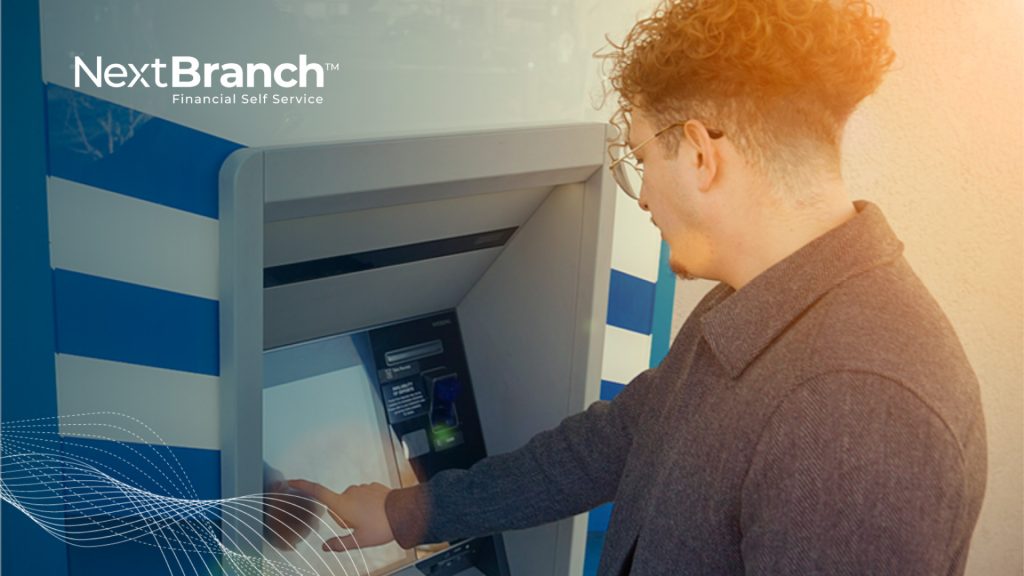
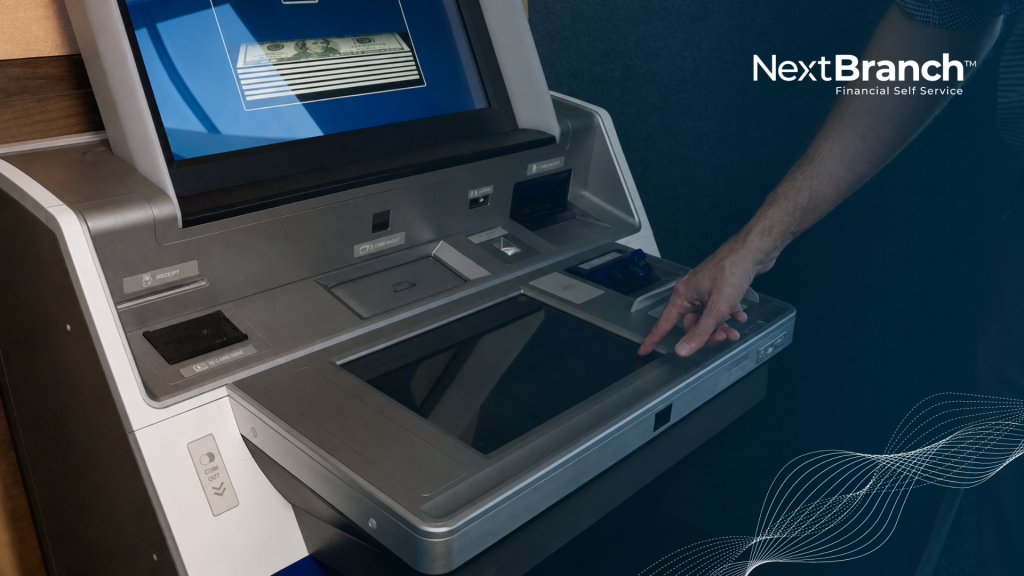
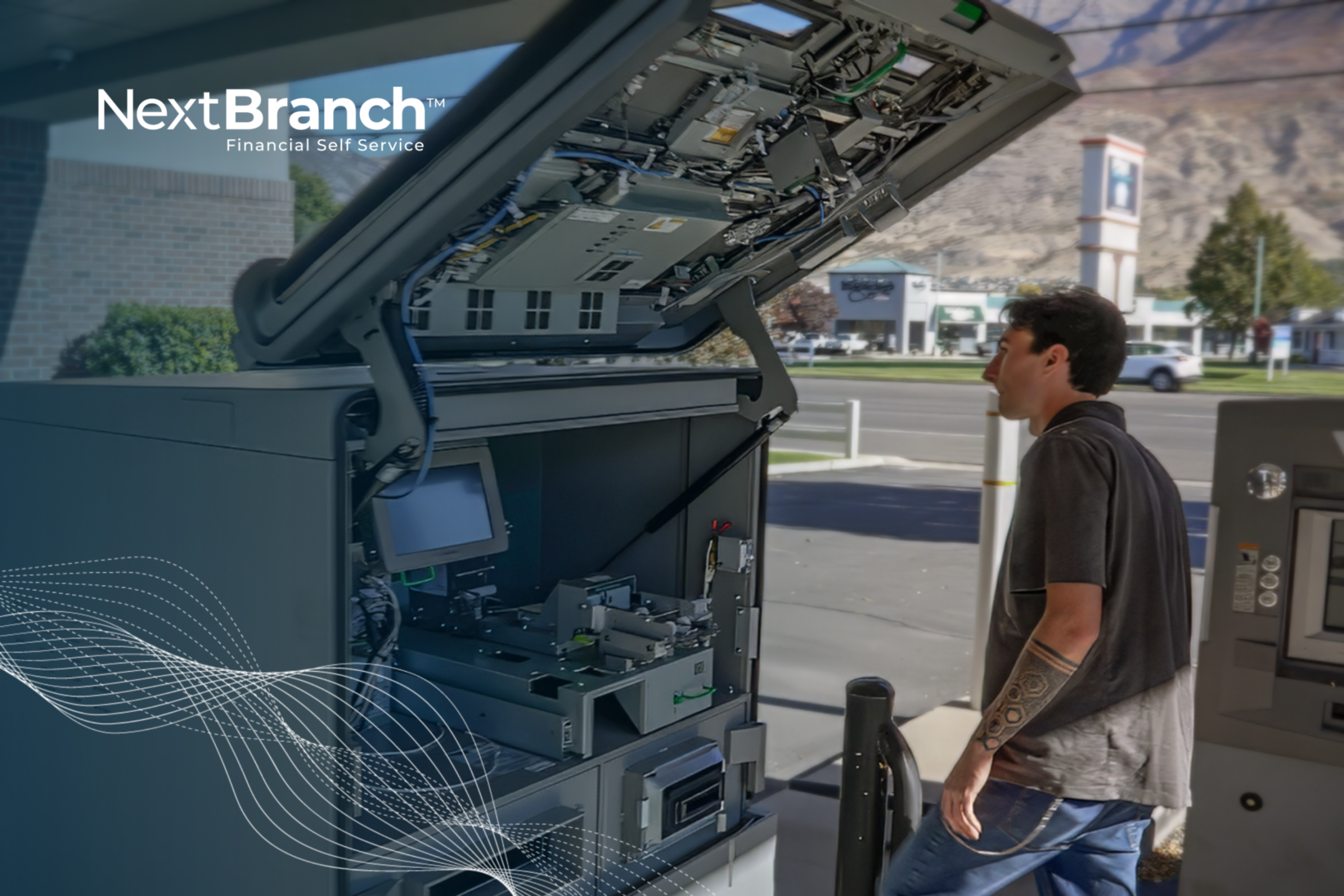
Interactive Teller Machines (ITMs) are the cornerstone of the transformed branch. An ITM does everything a traditional ATM does, cash withdrawals, deposits, balance inquiries, plus everything a teller does at the counter. When the machine is integrated with the financial institution’s core system, members and customers can access loan accounts, make loan payments, cash checks, withdraw higher amounts than a standard ATM allows, and print detailed statements. They can also connect to a live video teller when they need help or when a transaction requires authorization.
Teller Cash Recyclers (TCRs) replace the cash drawer at the remaining teller stations. A TCR accepts mixed cash, sorts and verifies it automatically, and dispenses it on demand. It serves as the branch’s secure cash storage, eliminating the need for a traditional vault, and it reduces cash-handling errors, speeds up transactions, and tightens security because cash never sits exposed on a counter.
Core integration is what makes the ITM strategy actually work. Without core integration, an ITM is essentially a more expensive ATM. With it, the machine becomes a true extension of the teller line: accessing the full account system, handling loan transactions, and enabling the kind of 90% transaction migration that makes the broader business case work.
The Digital-Physical Connection
A transformed branch that doesn’t connect cleanly to the digital channels around it is just a more architecturally interesting transactional building. The point of branch transformation is that the branch becomes one node in a connected experience, rather than the only place where members and customers can get something done.
Practically, that means a few things working together:
- Account opening that starts on mobile and finishes at the branch without re-keying information
- Loan applications that move between digital and in-person without losing context
- Appointment scheduling so members and customers know who they are meeting and what for
- Branch staff with access to the same digital interaction history the member or customer already has
This is the piece where many community banks and credit unions are weakest, often because their branch transformation initiative and their digital transformation initiative live under different leaders and report on different timelines. The institutions getting the highest return on branch transformation are the ones that treat their branch and digital initiatives as a single connected strategy rather than two parallel projects.
Why Now
Branch transformation isn’t a new idea. Larger banks have been doing versions of it for over a decade, but what has changed in the last few years is that the economics and the technology have both caught up with what community banks and credit unions specifically need.
Three shifts in particular
- ITM technology matured. Earlier ITMs were expensive, clunky, and required a 1 teller to 2 or 3 ITM ratio because the video teller drove every transaction. Modern assisted-self-service ITMs flip that ratio to 1 teller for 15 to 20 ITMs because the member or customer drives the interaction directly, only pulling in a teller for authorization or help.
- Core integration became standard. Major core providers (Fiserv, Jack Henry, FIS) now support ITM integration with reliable APIs, which means projects that used to take a year now take six to nine months.
- Outsourcing models changed the math. Instead of a financial institution taking on a million-dollar capital outlay to buy and deploy a fleet of ITMs, ATM outsourcing providers now offer the equipment, installation, service, compliance, and upgrades under a single monthly fee. That removes the upfront hurdle that stopped a lot of smaller institutions from transforming earlier.
The combination of those three shifts is why branch transformation is suddenly accessible to banks and credit unions that couldn’t justify it three years ago.
What Branch Transformation Is Not
A few clarifications, because the term gets used loosely:
- It is not branch closure. Closing branches is a cost-cutting exercise, while transforming branches is an operating model change, and although some institutions do both at the same time, the two are not the same strategic move.
- It is not eliminating staff. Done right, the headcount stays similar (or even grows in revenue-generating roles) while the mix shifts away from cash-handling and toward advisory work.
- It is not going all-digital. The data is consistent that members and customers still want a physical branch presence, especially for complex needs, which means the branch becomes more important to those high-trust moments rather than less important.
- It is not just buying ITMs. Without the parallel staffing shift, the layout change, and the digital integration, the machines underperform their potential and the project fails to deliver the promised return.
How to Measure Whether It’s Working
If your institution is planning a branch transformation, measuring the right things from the start will determine whether leadership sees it as a success a year in. The metrics worth baselining before the project begins include:
- Transaction migration rate. What percentage of teller transactions has shifted to self-service? Hawaii State FCU’s 90% is a useful benchmark.
- Branch-level revenue per FTE. This number should rise as staff shift toward revenue-generating roles.
- Net promoter score at transformed vs. traditional branches. A clean comparison if you’re doing a phased rollout.
- Member or customer satisfaction with self-service. The 96% figure from Hawaii State FCU is a reasonable target.
- Staff retention at transformed branches. Universal banker turnover should drop relative to traditional teller turnover.
- Operating cost per transaction. The cleanest way to demonstrate the financial case to a CFO.
Skipping the baseline measurement is the most common implementation mistake, because without numbers from before the project there is no clean way to demonstrate the change to leadership a year later.
How to Know If Your Institution Is Ready
Branch transformation isn’t a universal answer, and it works best when a few conditions are in place.
Your institution is a good candidate if:
- ATM or ITM equipment is within three years of end-of-life
- Branch foot traffic is declining but you’re not ready to close branches
- Teller hiring or turnover is a recurring operational challenge
- You’re expanding into new markets where branch costs need to be lower
- Core integration is supported by your provider (Fiserv, Jack Henry, FIS)
- Leadership is aligned that routine transactions should move to self-service
Your institution is probably not ready yet if:
- A core conversion is underway and won’t complete for over a year
- You recently purchased a new ATM fleet with significant remaining useful life
- Branch-level leadership is strongly opposed to reducing the teller-line model
Most institutions fall into the first group but haven’t started yet because the capital commitment felt too large to justify. Outsourcing changes that calculus.
Common Concerns, Answered Directly
“We’re worried about replacing staff with machines.” Every NextBranch customer that has gone through branch transformation has redeployed tellers into relationship roles rather than letting anyone go, and Yolo Federal Credit Union, for instance, has never done layoffs as part of their branch transformation. The shift is from counting cash to building relationships, which is a change in role rather than a change in employment status.
“Our members or customers won’t use ITMs.” The Hawaii State FCU data shows 96% of surveyed members across every generational segment said they would use the ITMs again, which suggests the assumption that older members won’t adopt the technology doesn’t hold up in practice as long as the onboarding and signage are handled well.
“This feels like a massive project.” It can be, but it can also be phased. Yolo FCU took roughly two years to complete their transformation by running it in two phases, first replacing the ATM fleet with ITMs, then connecting to the core after a parallel core conversion completed. The right outsourcing partner will structure the project around your calendar rather than theirs.
“What if the technology fails or has downtime?” The honest answer is that technology fails sometimes, and the more useful question is how quickly it gets resolved when it does. In 2025, NextBranch operated at 99% uptime across more than 7,000 machines, and 54% of service events were resolved remotely without dispatching a technician. That is the benchmark to ask any potential partner to match.
Where to Start
If your institution is exploring branch transformation for the first time, the most useful next step is usually a conversation with a partner that has done this for community banks and credit unions specifically, rather than a generalist technology vendor. The operational details matter, and what works for a community institution often differs significantly from what works for a multi-state regional bank.
NextBranch works exclusively with banks and credit unions and has executed branch transformations ranging from a single flagship branch to multi-branch rollouts across multiple states. Every operations team member has at least ten years in the financial institution sector.
NextBranch is a subsidiary of Grant Victor, Hyosung’s largest U.S. reseller partner and 2025 Partner of the Year. Together, Grant Victor companies own and operate over 7,000 ATMs, ITMs, and TCRs nationwide. If you’d like to explore what branch transformation could look like for your institution, schedule a consultation.Schedule a Consultation
Frequently Asked Questions
What is branch transformation?
It is the operational, technological, and staffing shift that moves routine transactions out of the teller line and into self-service channels. Four parts have to move together: self-service technology, redesigned staffing, a rethought physical footprint, and real integration between digital and branch channels.
Are branches still worth investing in?
Branch counts at FDIC-insured commercial banks started rising again in 2023. Two thirds of consumers value having a neighborhood branch, and 71 percent still go to one for complex needs such as mortgages, retirement planning, and small business banking.
Does branch transformation mean cutting teller jobs?
No. Institutions redeploy tellers into relationship roles that pay about 35 percent more. WSECU reached a double-digit FTE reduction through attrition with no forced terminations, and Yolo Federal Credit Union has never had a layoff through its transformation.
Will members actually use ITMs?
Hawaii State Federal Credit Union surveyed its members and 96 percent said they would use an ITM again, across every age group. NextBranch ran 99 percent uptime across more than 7,000 machines in 2025 and resolved 54 percent of service events remotely.